ホーム

Punching life priority slitter blades

最新のブログ
タグ

Punching life priority slitter blades

  • Vacuum Heat Treatment vs. Salt Bath Heat Treatment for Slitter Blades — How Big Is the Performance Difference?
    Aug 25, 2026
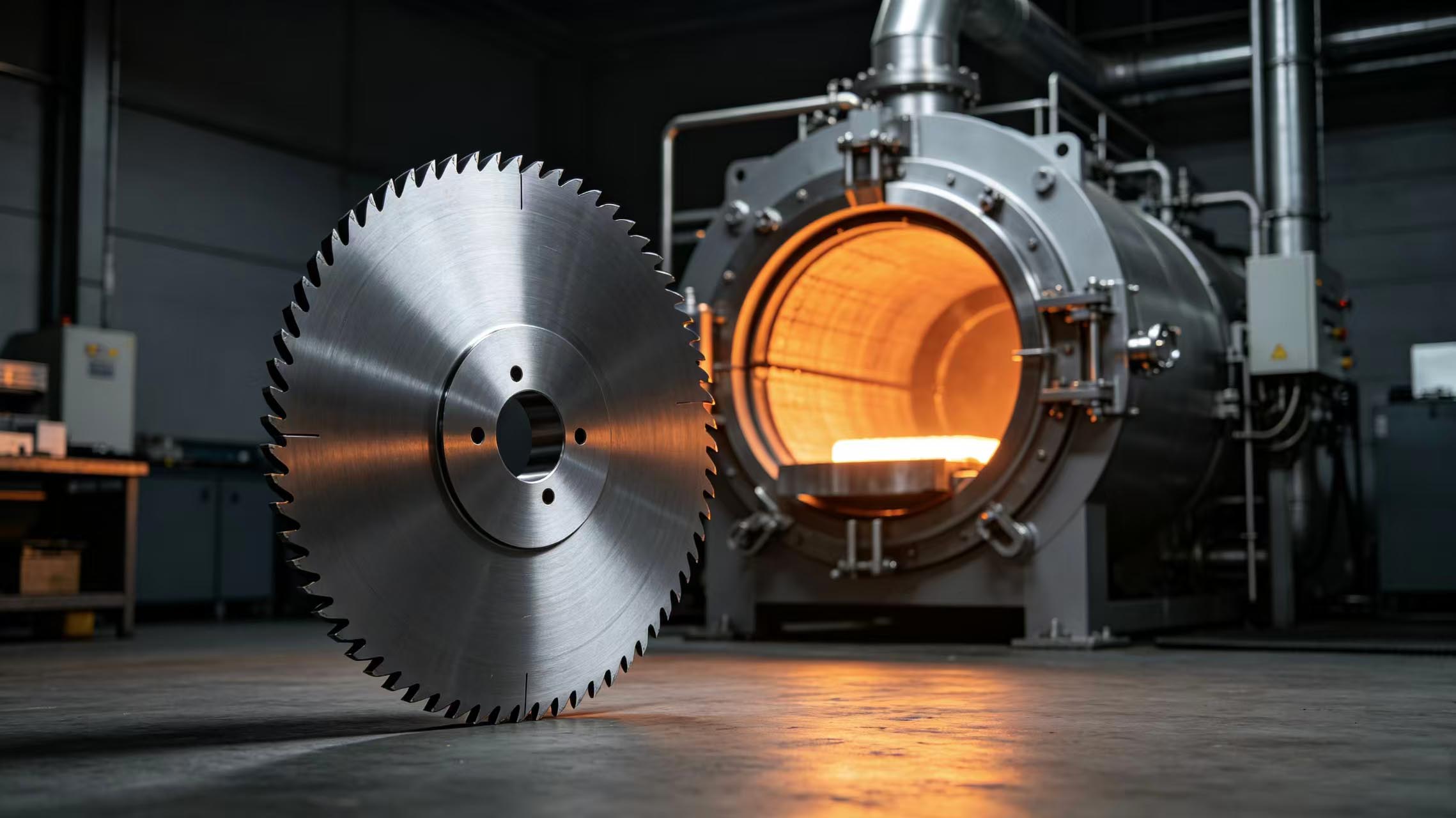
    In slitter blade manufacturing, heat treatment is one of the most critical processes, directly determining blade hardness, toughness, wear resistance, and service life. Currently, there are two mainstream heat treatment methods in the industry: vacuum heat treatment and salt bath heat treatment. Many users only focus on the final hardness value of the blade, but overlook the profound impact that differences in the heat treatment process itself have on performance. Mingbai Mechanical Tool Technology Co., Ltd., based on years of heat treatment practice, provides you with an in-depth comparison of the performance gap between these two processes.   1. The Fundamental Difference Between the Two Heat Treatment Methods   Vacuum heat treatment is a heat treatment process in which blades are heated, held, and cooled in a vacuum state (10⁻¹~10⁻⁵Pa). Throughout the entire process, the blades are not exposed to air, completely avoiding oxidation and decarburization, with good heating uniformity and minimal deformation.   Salt bath heat treatment involves immersing blades in molten salt (such as barium chloride, sodium chloride, etc.) for heating and quenching. Salt bath heating is fast and has good temperature uniformity, but the blade surface reacts with impurities in the salt bath, resulting in some decarburization and corrosion.   The most core difference between the two is: vacuum heat treatment is "clean heating," while salt bath heat treatment is "medium heating."   2. Surface Quality Gap   Vacuum heat treated slitter blades have a silver-gray metallic luster on the surface, with no oxide scale and no decarburized layer, ready for subsequent processing. In contrast, blades treated with salt bath heat treatment develop an oxide scale and decarburized layer on the surface, typically requiring additional shot blasting or grinding operations for removal. This not only increases processing costs but also reduces the effective thickness of the blade.   Measurement comparison: the decarburized layer depth on vacuum heat treated blades can be controlled within 0.01mm, while the decarburized layer depth on salt bath heat treated blades is typically between 0.05-0.15mm. For high-precision decarburization-free slitter blades, vacuum heat treatment has a clear advantage.     3. Deformation and Dimensional Accuracy Differences   Vacuum heat treatment uses gas quenching or oil quenching, providing good cooling uniformity and minimal blade deformation. For complex-shaped slitter blades such as thin sheets, special shapes, and long strips, the flatness and roundness dimensional accuracy after vacuum heat treatment is far superior to salt bath heat treatment. Salt bath heat treatment, affected by the cooling medium and immersion method, often results in warping and oval deformation. Taking a circular blade with 200mm diameter and 3mm thickness as an example, flatness after vacuum heat treatment can be controlled within 0.02mm, while after salt bath heat treatment, flatness is typically 0.05-0.08mm.     4. Hardness and Impact Toughness Comparison   Both processes can achieve the same hardness value (e.g., HRC60-64), but there is a gap in impact toughness. Vacuum heat treatment provides better blade toughness due to uniform heating and no surface defects, making it less prone to chipping under impact loads. Salt bath heat treatment may result in a 10%-20% reduction in toughness due to surface micro-decarburization or grain boundary corrosion. For punching life priority slitter blades, vacuum heat treatment provides a longer stable cutting cycle. For applications subject to heavy impact, high-toughness slitter blades should prioritize vacuum heat treatment.     5. Environmental Friendliness and Cost   Salt bath heat treatment uses salt bath media such as barium chloride, producing hazardous waste gas and waste salt, with high environmental treatment costs. Vacuum heat treatment is a fully enclosed clean process with no exhaust gas or wastewater emissions, meeting modern green manufacturing requirements. Although vacuum heat treatment equipment investment is higher, considering environmental treatment and subsequent processing costs, the overall costs are essentially comparable.     6. Selection Recommendations for Different Working Conditions   High-precision slitting, thin material slitting: choose vacuum heat treatment for minimal deformation and high precision. Heavy rough cutting, impact conditions: choose vacuum heat treatment for better toughness and chipping resistance. Conventional slitting, low surface requirements: salt bath heat treatment is acceptable, with slightly lower cost. Strict environmental requirements, export orders: vacuum heat treatment is mandatory.   7. Mingbai Technology's Heat Treatment Capabilities   Mingbai Mechanical Tool Technology Co., Ltd. is equipped with advanced vacuum heat treatment furnaces, using computer-controlled temperature throughout the process with temperature uniformity of ±5°C. Each batch of vacuum heat treated slitter blades comes with heat treatment process records and metallographic inspection reports. We also offer upgrade services to convert salt bath heat treated blades to vacuum heat treatment, helping customers improve life and precision without changing blade material.     Conclusion   The performance differences between vacuum heat treatment and salt bath heat treatment for slitter blades are mainly reflected in four aspects: surface quality, deformation control, toughness, and environmental friendliness. Vacuum heat treatment leads comprehensively in precision, life, and environmental protection, especially suitable for high-precision and high-demand applications. Although equipment investment is higher, the overall benefits are significant. Mingbai Technology is ready to provide you with superior-performance slitter blades with advanced heat treatment capabilities.   FAQ :   Q1: How much more expensive is vacuum heat treatment compared to salt bath heat treatment? A: The per-piece cost of vacuum heat treatment is typically 15%-30% higher than salt bath, but it eliminates subsequent shot blasting and grinding processes, making the overall cost essentially comparable. For high-precision blades, the overall cost of vacuum heat treatment can even be lower.   Q2: How much longer do vacuum heat treated blades last compared to salt bath treated blades? A: Under the same working conditions, vacuum heat treated blades typically last 20%-50% longer than salt bath treated blades. The main reasons are the absence of surface decarburization defects, more uniform microstructure, and stronger resistance to wear and chipping.   Q3: Will salt bath heat treatment be completely phased out? A: Salt bath heat treatment still has a market for some low-requirement applications due to its fast heating speed and low equipment investment. However, due to environmental policy restrictions and increasing precision requirements, vacuum heat treatment is gradually replacing salt bath heat treatment as the mainstream process.   Q4: How can you tell whether a blade has been vacuum heat treated or salt bath heat treated? A: Look at the surface condition. Vacuum heat treated blades have a uniform silver-gray surface with no oxide scale. Salt bath heat treated blades often have an uneven dark gray or black oxide layer on the surface, and may have fine corrosion spots.   Q5: Do blades still need grinding after vacuum heat treatment? A: Yes. Blades still have slight deformation after vacuum heat treatment, and the edge needs precision grinding to achieve final dimensions and sharpness. However, the grinding allowance is less than with salt bath heat treatment, preserving more effective thickness. Website: www.mingbaiblade.com
伝言を残す
弊社の製品にご興味があり、詳細を知りたい場合は、こちらにメッセージを残してください。できるだけ早く返信させていただきます。
提出する

伝言を残す

伝言を残す
弊社の製品にご興味があり、詳細を知りたい場合は、こちらにメッセージを残してください。できるだけ早く返信させていただきます。
提出する

ホーム

製品

ワッツアップ

お問い合わせ